Builder-Buyer Agreement - Clauses to Check
Published On: 25 June 2026

The builder buyer agreement clauses you sign decide what you can enforce later — not the glossy brochure, not the sales conversation. For a home like Godrej Brooklyn Avenue in Kukatpally, west Hyderabad, the legally binding document is the Agreement for Sale (often called the builder-buyer agreement, or BBA). It is executed by Godrej Properties and registered after you pay the booking amount and the first instalment. This page walks you through the agreement clause by clause, in plain language, so you know exactly what to verify before you sign. As of 2026, treat this as a buyer checklist and always have the final draft reviewed by a property lawyer before execution.
Godrej Brooklyn Avenue is RERA approved in Telangana under registration number P02200010981. The project is under construction with possession slated for June 2031. Pricing currently runs from about Rs 2.10 Cr to Rs 4.40 Cr, on a base rate near Rs 12,500 per sq.ft, across configurations sized 1,588 to 3,261 sq.ft (super built-up). Those numbers matter because almost every clause below — price, area, payment, penalty — should be read against them.
What the Builder-Buyer Agreement Actually Is
Under the Real Estate (Regulation and Development) Act, 2016 and the Telangana RERA rules, a promoter cannot accept more than 10% of the apartment cost as an advance without first executing a written, registered Agreement for Sale. So the agreement is not a formality you can skip — it is the legal backbone of your purchase. It records who is selling, what is being sold, the exact area, the price, the payment timeline, the handover date and the remedies if either side defaults. The Expression of Interest (EOI) booking amount at this project is Rs 5 to 6 Lakhs and is refundable; that EOI does not replace the agreement, it precedes it.
Builder-Buyer Agreement Clauses to Check — Clause-by-Clause Table
Read every clause below in your own draft. The table summarises what to look for and why it protects you.
| Clause | What to look for | Why it protects you |
| Parties & title | Promoter named as Godrej Properties; clear marketable title and the land schedule attached | Confirms you are buying from the rightful owner and on the correct land parcel |
| RERA carpet area | Carpet area stated in sq.ft, plus the super built-up area and the loading factor | RERA price and possession are tied to carpet area, not super area — this is what you actually own |
| Total consideration | Base price, floor-rise, PLC, car park, GST and statutory charges itemised | Stops hidden charges being added after booking |
| Payment schedule | Construction-linked milestones with dates/stages and amounts | You pay as the building rises, not all upfront |
| Possession date | A specific calendar date — here June 2031 — not "tentative" | Fixes the handover deadline you can enforce |
| Delay compensation | Interest payable by the builder for late handover, at the same rate you pay for late instalments | RERA requires symmetrical interest; protects you if possession slips |
| Grace period | Length of any grace window beyond possession date (commonly 6 months) | Tells you when delay penalty actually begins |
| RERA reference | Registration number P02200010981 and the RERA web link printed in the agreement | Lets you verify the project on the Telangana RERA portal |
| Specifications annexure | Fittings, finishes and brand-equivalent materials listed in a signed annexure | Holds the builder to the quality promised, not just shown in samples |
| Amenities schedule | Common amenities, completion stage and which are chargeable | Prevents amenities being dropped or billed later |
| Force majeure | A closed list of genuine events (natural disaster, government order); not open-ended | Stops the builder from claiming endless "circumstances beyond control" |
| Default & cancellation | What counts as default, cure period, and the refund formula on cancellation | Caps forfeiture and defines your exit terms |
| Refund of EOI | EOI of Rs 5–6 Lakhs stated as refundable, with a clear timeline | Secures your booking money if you withdraw before agreement |
| Maintenance & corpus | Monthly maintenance rate, one-time corpus/sinking fund, and handover to the association | Tells you the recurring cost and who runs the society later |
| Car parking | Number and type of parks allotted, mapped to the price | Avoids paying for parking you were not allotted |
| Transfer / assignment | Whether and how you may resell or assign before registration, and any fee | Protects resale flexibility and caps transfer charges |
| Dispute resolution | Jurisdiction, Telangana RERA / adjudicating officer route, arbitration terms | Defines where and how you enforce your rights |
The Five Clauses That Cause the Most Disputes
1. RERA Carpet Area vs Super Built-Up Area
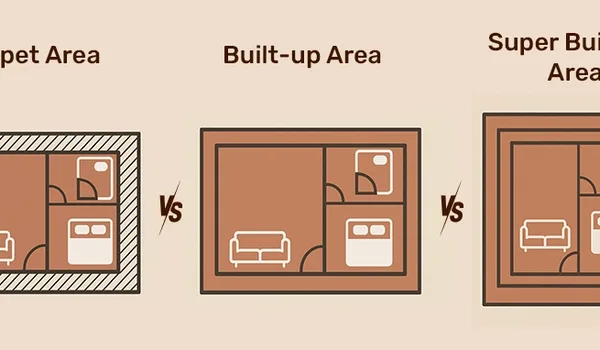
This is the single most misread clause. The brochure quotes super built-up area — 1,588 to 3,261 sq.ft here — but RERA pricing and possession obligations attach to the carpet area, the net usable floor space within your walls. The difference between the two is the loading factor. Confirm the agreement states carpet area explicitly and that any later area correction at completion is capped (a small variation is normal; a large jump is a red flag). If you are unsure how the two differ, read our explainer on carpet area versus built-up versus super built-up area before you sign.
2. Total Consideration and the Payment Schedule
The price clause should itemise the base rate (about Rs 12,500/sq.ft), floor-rise, preferred-location charges, car parking, GST and statutory dues — not bundle them into one number. The payment schedule should be construction-linked, releasing money as slabs and structures are cast. Worked example: a 1,588 sq.ft home at roughly Rs 12,500/sq.ft works out near Rs 1.99 Cr before charges, landing in the Rs 2.10 Cr band once taxes and extras apply; a 3,261 sq.ft unit sits at the Rs 4.40 Cr end. Match each milestone amount to the total so the percentages add up. For the full breakdown, see the construction-linked payment plan.
3. Possession Date and Delay Compensation
Look for a hard calendar date — June 2031 at this project — and not the word "tentative". Then read the delay clause directly below it. Under RERA the builder must pay you interest for delayed possession at the same rate you would pay for a delayed instalment; the agreement should say so in plain terms. Note any grace period (typically up to six months) because that is when the penalty meter actually starts. If the builder's delay interest is lower than your default interest, that asymmetry is a clause to negotiate.
4. Default, Cancellation and Refund
Find out what the builder treats as your default, how many days you get to cure it, and exactly how much is forfeited if you cancel. A fair clause forfeits only a defined, reasonable sum and refunds the rest within a stated number of days. The EOI of Rs 5 to 6 Lakhs is refundable at this stage, but once the agreement is registered the forfeiture terms in this clause take over — so understand them before, not after.
5. Force Majeure
A reasonable force majeure clause lists specific, genuine events that excuse a delay. Reject open-ended wording like "any circumstances beyond the builder's control", which can be stretched to cover ordinary project slippage. The list should be closed and the relief proportionate to the actual event.
Red Flags — Negotiate or Walk Away
- One-sided penalty rates — you pay 18% on late payments but the builder pays far less for late possession
- "Tentative" possession date — no enforceable handover deadline
- Open-ended force majeure — vague "beyond control" language with no closed list
- Price tied to super built-up area only — carpet area missing or loading factor undisclosed
- High, undefined cancellation forfeiture — no fixed amount, no refund timeline
- Missing RERA number — agreement that does not print P02200010981 and the portal link
- Amenities only in the brochure — not carried into a signed specifications annexure
Before You Sign — A Quick Buyer Workflow
Run the agreement against the project's RERA record, then against your own checklist. Verify the registration on the state portal, cross-check the area and price clauses, and confirm the penalty and refund terms are symmetrical. A short, structured legal due diligence pass at this stage catches almost every issue that becomes a dispute later. If the agreement clears that pass, the rest of the purchase — booking, registration, payment — follows the standard step-by-step booking process. As of 2026, none of the above is a substitute for advice from a qualified property lawyer who reviews your specific draft.
Frequently Asked Questions about Builder-Buyer Agreement Clauses
1. What is the most important clause in a builder-buyer agreement?
There is no single clause, but three carry the most weight: the RERA carpet area clause (what you actually own), the possession date with its delay-compensation clause (when you get it and what happens if you do not), and the total consideration with the payment schedule (what you pay and when). Verify these first. As of 2026, have a property lawyer confirm the wording before you sign.
2. Is the builder-buyer agreement the same as the Agreement for Sale?
In practice, yes. Under RERA the legally registered document is the Agreement for Sale, and the term "builder-buyer agreement" or BBA is used interchangeably for it. At Godrej Brooklyn Avenue it is executed by Godrej Properties and registered after the booking amount and first instalment are paid.
3. Should the agreement use carpet area or super built-up area?
RERA requires price and possession to be tied to carpet area — the net usable space inside your walls. Brochures quote super built-up area (1,588–3,261 sq.ft at this project), which includes a loading factor. A correct agreement states both, with the carpet area and the loading clearly disclosed so you know exactly what you are paying for.
4. What happens if the builder delays possession beyond June 2031?
If the delay clause follows RERA, the builder must pay you interest for every month of delay after the possession date and any stated grace period, at the same rate you would pay on a late instalment. Read this clause carefully and reject any version where the builder's delay rate is lower than your default rate.
5. Is the booking amount refundable if I cancel before the agreement?
At Godrej Brooklyn Avenue the Expression of Interest (EOI) booking amount of Rs 5 to 6 Lakhs is refundable at the pre-agreement stage. Once the Agreement for Sale is registered, the cancellation and forfeiture clause in the agreement applies instead, so understand that clause and its refund timeline before you execute the document.
6. Do I need a lawyer to review the builder-buyer agreement?
It is strongly recommended. A property lawyer checks the title, the RERA registration (P02200010981), the area and price clauses, and the penalty, force majeure and refund terms against current Telangana practice. As of 2026, the checklist on this page is a starting point, not legal advice — verify the final draft with a lawyer before signing.
Godrej Brooklyn Avenue Blog