Carpet Area vs Built-Up vs Super Built-Up Area — What You Actually Buy
Published On: 25 June 2026
When you read a brochure that says "1,588 sq.ft" or "3,261 sq.ft", which number are you actually buying? It is one of the most misunderstood parts of a home purchase, and getting it wrong can mean comparing two flats on completely different scales. Three terms do the heavy lifting here: carpet area, built-up area and super built-up area. They are not interchangeable, and the gap between them — known as the loading factor — directly affects how much usable space your money buys. This guide explains each term in plain English, walks through a worked example tied to Godrej Brooklyn Avenue in Kukatpally, and shows you how to compare two projects fairly. The data here is current as of 2026; always confirm the exact areas on the sanctioned plan and the RERA portal before you sign.
The Three Areas, Defined Simply
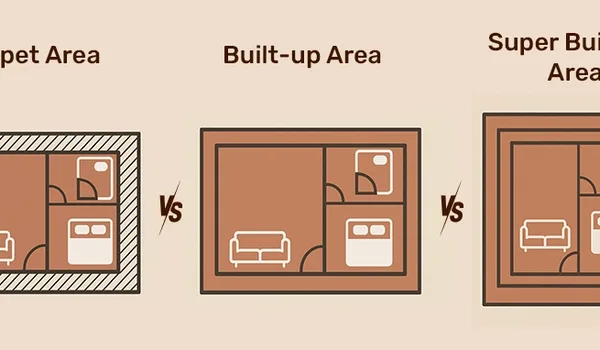
Think of an apartment as a set of nested boxes. The smallest box is the space you can actually lay a carpet on. The next box adds the walls and balcony. The largest box adds your fair share of everything outside your front door — the lobby, lifts and stairwells. Each step adds area you pay for but use differently.
| Term | What it includes | What it leaves out |
| Carpet area | Net usable floor inside the flat — bedrooms, living, kitchen, internal passages, bathrooms (the floor you can walk on) | Wall thickness, balconies, common areas |
| Built-up area | Carpet area + the thickness of internal and external walls + balcony/utility | Lobby, lifts, stairs and other shared spaces |
| Super built-up area | Built-up area + a proportionate share of common areas (lobby, lifts, stairwells, corridors, sometimes clubhouse) | Nothing — it is the largest figure |
Carpet area is the only figure you can furnish and live in. Built-up area is roughly 10–15% larger because walls and balconies have real footprint. Super built-up area is larger still, because it spreads the building's shared infrastructure across every flat.
The RERA Carpet-Area Rule — Why It Changed Everything
Before the Real Estate (Regulation and Development) Act, developers across India quoted super built-up area, which made flats look bigger and the per-sq.ft rate look smaller. Two projects could advertise the same "1,500 sq.ft" while delivering very different usable space. RERA fixed this. Under the Act, builders must declare and sell on carpet area — the net usable area within the walls of the apartment. The agreement and the RERA-registered details carry the carpet number, so what you sign for is the space you can actually use. Godrej Brooklyn Avenue is a RERA-approved project (Telangana RERA No. P02200010981), which means its declared areas follow this carpet-area discipline and are verifiable on the official portal.
Loading Factor — The Number That Explains the Gap
The "loading factor" is the percentage added to carpet area to arrive at super built-up area. A 30% loading means a flat with 1,000 sq.ft of carpet is sold as 1,300 sq.ft super built-up. A lower loading factor is better for the buyer — more of what you pay for is inside your home. As a working rule used widely in 2026, carpet area is roughly 70% of built-up area, with super built-up adding common-area share on top. Premium towers with large lobbies, multiple high-speed lifts and a sizeable clubhouse — like the 75,000 sq.ft clubhouse at Godrej Brooklyn Avenue — naturally carry some loading, because those shared facilities are part of what you enjoy. The point is not to fear loading, but to know it and compare like with like.
Worked Example — Using Godrej Brooklyn Avenue Sizes
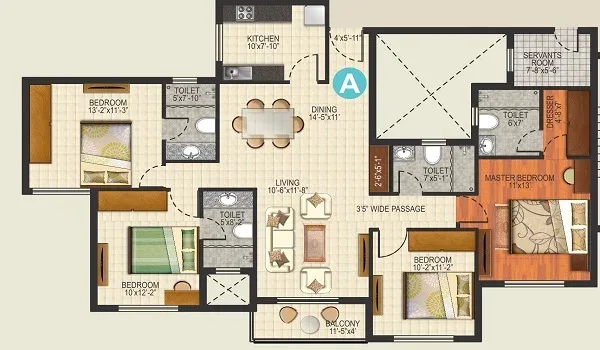
Godrej Brooklyn Avenue offers homes from 1,588 sq.ft to 3,261 sq.ft. Let us treat three representative super built-up sizes and back out an approximate carpet figure using the ~70% built-up ratio, then a typical loading. These are illustrative — the sanctioned plan carries the exact split, so verify the real carpet number for any specific unit you shortlist.
| Configuration | Stated size (super built-up, sq.ft) | Approx. carpet (~70%) | What it means |
| 3 BHK Premium | 1,588 | ~1,112 | Net usable space you furnish |
| 3 BHK Luxury | 2,200 (illustrative) | ~1,540 | Larger living and bedrooms |
| 4 BHK + Servant | 3,261 | ~2,283 | Maximum usable footprint |
The takeaway: a brochure number of 1,588 sq.ft does not mean 1,588 sq.ft of furnishable floor. The usable carpet is closer to 1,100 sq.ft, with the rest accounted for by walls, balconies and your share of common areas. When you study the Godrej Brooklyn Avenue floor plans, ask the sales team for the carpet figure of the exact unit number, not just the marketing size.
Why It Matters for Price Comparison
The cleanest way to compare two projects is price per carpet sq.ft, not price per super built-up sq.ft. A project quoting a low headline rate on a heavily loaded super built-up area can actually be more expensive per usable foot than a project with a higher headline rate but lower loading. To run the comparison properly: take the total price, divide by carpet area for each option, and compare those two numbers. Pair this with the all-in cost — stamp duty, GST and registration — which we break down on the Godrej Brooklyn Avenue cost sheet, so you are comparing total outflow against real usable space.
What to Check Before You Sign
- Ask for the carpet area in writing — it should appear in the agreement and match the RERA-registered figure
- Confirm the loading factor — compute (super built-up ÷ carpet) and compare across shortlisted projects
- Check what "common area" includes — clubhouse, lobby, lifts and stairs are standard; confirm nothing unusual is loaded in
- Compare on carpet ₹/sq.ft — never compare two flats on super built-up rate alone
- Verify on the RERA portal — cross-check declared areas against the registration details (P02200010981)
Who This Matters Most For
First-time buyers benefit most, because the carpet-versus-super-built-up gap is exactly where surprises happen. Investors should care too — rental rates and resale values track usable space, so a higher loading factor quietly erodes yield. Upgrade buyers moving from an older flat should compare the new carpet area against their current home, not the brochure size, to know whether they are genuinely gaining room. Whatever your profile, insist on the carpet number and you will never overpay for space you cannot use.
Frequently Asked Questions about Carpet, Built-Up and Super Built-Up Area
1. What is the difference between carpet area and super built-up area?
Carpet area is the net usable floor inside your flat — the space you can actually furnish and walk on. Super built-up area is carpet area plus walls and balcony plus your proportionate share of common areas like the lobby, lifts and stairwells. Super built-up is always the larger figure, which is why it was used in older brochures to make flats look bigger. As of 2026, the difference between them is captured by the loading factor.
2. Does RERA require builders to sell on carpet area?
Yes. Under the Real Estate (Regulation and Development) Act, builders must declare and sell on carpet area — the net usable area within the apartment walls. The carpet figure appears in the sale agreement and the RERA registration, so what you sign for is the space you can use. Godrej Brooklyn Avenue is RERA-approved (Telangana RERA No. P02200010981), and its declared areas can be verified on the official portal.
3. What is a loading factor and what is a good number?
The loading factor is the percentage added to carpet area to reach the super built-up area. If a flat with 1,000 sq.ft carpet is sold as 1,300 sq.ft, the loading is 30%. A lower loading factor means more of what you pay for is inside your home. As a 2026 working rule, carpet area is roughly 70% of built-up area, with super built-up adding common-area share on top. Premium towers with large lobbies and clubhouses carry some loading by design.
4. What is the carpet area of a 1,588 sq.ft flat at Godrej Brooklyn Avenue?
Using the ~70% built-up ratio as a guide, a stated 1,588 sq.ft 3 BHK works out to roughly 1,100–1,150 sq.ft of usable carpet, with the balance made up of walls, balcony and common-area share. This is illustrative — the sanctioned plan carries the exact carpet number for each specific unit, so always ask the sales team for the carpet figure of the unit you shortlist and confirm it in the agreement.
5. How should I compare two projects on price per sq.ft?
Always compare on price per carpet sq.ft, not per super built-up sq.ft. Take each project's total price and divide by its carpet area, then compare those two numbers. A low headline rate on a heavily loaded super built-up area can be more expensive per usable foot than a higher headline rate with low loading. Combine this with the full acquisition cost — stamp duty, GST and registration — to know the true cost per usable square foot.
Godrej Brooklyn Avenue Blog