Buy vs Rent in Hyderabad - The Real Math (2026)
Published On: 25 June 2026
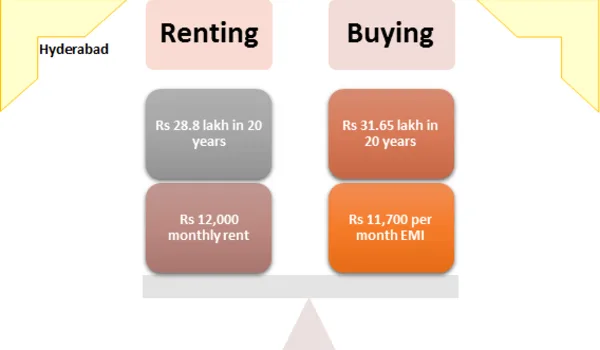
The buy vs rent Hyderabad debate rarely gets a straight answer because most comparisons skip the numbers. So let us do the real math. Renting feels cheaper month to month, and on day one it usually is. Buying, on the other hand, converts a monthly outgo into an owned asset that appreciates. The honest answer depends on your time horizon, the price you pay, the rate you borrow at, and how fast the property grows. Below we work through a full 15-year comparison using a live example - Godrej Brooklyn Avenue by Godrej Properties in Kukatpally, west Hyderabad - priced from Rs 2.10 Cr with a base rate of about Rs 12,500/sq.ft and possession in June 2031. The project is RERA approved under Telangana No. P02200010981. All rates below are as of 2026; verify the current figures with your bank.
The Starting Numbers (As of 2026, Verify With Your Bank)
To compare fairly, fix the inputs first. A typical Hyderabad home loan in 2026 carries an interest rate of about 7.75% p.a. Lenders fund 75-90% of the property value (loan-to-value), so on a Rs 2 Cr home you would put down Rs 20-50 lakh and borrow the rest. Stamp duty and registration in Telangana run to roughly 6% of the deal value, with a small concession (around 5%) where the property is registered in a woman's name. For the example purchase we assume a Rs 2 Cr loan. At 7.75%, the EMI works out to about Rs 1,64,190 per month over a 20-year tenure, or about Rs 1,43,282 per month if you stretch it to 30 years. Verify both with your own lender - your rate and tenure move the answer.
On the Rent Side
Kukatpally is a healthy rental market. A 2 BHK rents for roughly Rs 18,000-32,000 per month, a 3 BHK for about Rs 28,000-55,000 per month, and a luxury 3 BHK in a premium tower for Rs 50,000-85,000 per month. Gross rental yields in the catchment sit at 3.5%-5.5%. For an apartment comparable to a Godrej Brooklyn Avenue 3 BHK, a starting rent of around Rs 45,000 per month is a fair benchmark, and Hyderabad rents have historically escalated about 7% a year. Our rental yield in Kukatpally page breaks the yield logic down further.
The 15-Year Buy vs Rent Comparison
The table below runs a like-for-like 15-year horizon. On the buy side we use a Rs 2.10 Cr purchase (a Rs 2 Cr loan after a ~Rs 30 lakh down payment), a 20-year EMI, 6% stamp duty and registration, maintenance, and the opportunity cost of the cash you lock into the down payment. On the rent side we start at Rs 45,000 per month and escalate 7% a year, with that down-payment cash instead invested. Figures are rounded and illustrative; treat them as a framework, not a quote.
| Line item (15-year horizon) | Buy (Godrej Brooklyn Avenue 3 BHK) | Rent (comparable 3 BHK) |
| Up-front cash (down payment) | Rs 30 lakh | Rs 0 |
| Stamp duty + registration (~6%) | Rs 12.6 lakh | Rs 0 |
| Monthly outgo (start) | Rs 1,64,190 EMI | Rs 45,000 rent |
| 15-year EMI / rent paid | ~Rs 2.96 Cr (EMI) | ~Rs 1.36 Cr (rent at 7% escalation) |
| Maintenance over 15 yrs | ~Rs 12-15 lakh | Borne by landlord |
| Down-payment opportunity cost | Already deployed in the home | ~Rs 30 lakh invested, grows alongside |
| Asset owned at year 15 | The apartment + ~5 yrs of loan still due | None |
| Est. property value at year 15 (~8% appreciation) | ~Rs 6.6 Cr | Not applicable |
| Net position at year 15 | Equity-rich: asset value far exceeds outstanding loan | No asset; paid ~Rs 1.36 Cr in rent with nothing retained |
Reading the Math - The Break-Even
The first few years almost always favour renting. Your EMI is far higher than your rent, you have paid stamp duty and registration up front, and most of each early EMI is interest, not principal. That is the trap in the buy vs rent debate - people judge it on year one. But two forces flip the equation over time. First, rent never stops climbing; at 7% escalation a Rs 45,000 rent crosses Rs 1.2 lakh inside 15 years and keeps going forever. Your EMI, by contrast, is fixed in rupee terms and ends when the loan does. Second, the home appreciates. Hyderabad has been among India's fastest-growing property markets, and homes within walking distance of a metro station - Godrej Brooklyn Avenue sits near JNTU College Metro on the Red Line - have shown 10-30% higher appreciation than the city average.
Put those together and the break-even - the point where buying becomes cheaper than renting on a total-wealth basis - typically lands somewhere between years 7 and 11 for a metro-linked Hyderabad home bought at a fair price. Before that window, a disciplined renter who invests the saved cash can stay ahead. After it, the owner pulls away and the gap widens fast, because they hold a multi-crore appreciating asset while the renter holds only a rent receipt. If you want to model your own EMI and tenure precisely, our home loan and EMI guide walks through the calculation step by step.
Honest Pros and Cons
| Option | Pros | Cons |
| Buy | Builds equity; appreciation upside; fixed EMI vs rising rent; home-loan tax benefits; full ownership and freedom to renovate; protection against rent inflation. | Large up-front cash; stamp duty and registration; maintenance and repairs on you; lower liquidity; EMI commitment for 20-30 years. |
| Rent | Low entry cost; high mobility; no maintenance liability; frees cash for other investments; easy to right-size as needs change. | No equity built; rent escalates ~7% a year with no end; no appreciation gain; subject to landlord decisions and renewals. |
Who Should Buy vs Who Should Rent
You Should Buy If
- You will stay 7+ years - the longer your horizon past break-even, the more decisively buying wins. A Godrej Brooklyn Avenue home, starting at Rs 2.10 Cr with possession in June 2031, suits buyers planning for the long term.
- You have the down payment without straining - Rs 20-50 lakh plus ~6% stamp duty should not empty your emergency fund.
- Your income is stable - a 20-year EMI of about Rs 1,64,190 is comfortable when it stays well under 40% of take-home pay.
- You want an appreciating, inflation-protected asset - metro-proximity and Hyderabad's growth make the math attractive over a full cycle.
You Should Rent If
- Your horizon is under 5 years - you may exit before break-even and lose money on transaction costs.
- Your job or city may change soon - mobility is worth more than equity when you are not settled.
- You would over-leverage to buy - if the EMI crowds out savings and investments, renting and investing the difference is the safer play.
- You can earn more elsewhere - a disciplined investor who reliably beats property returns can justify renting; most people do not stay that disciplined. Compare a real listing on our rent page before deciding.
The Bottom Line
Buy vs rent in Hyderabad is not a one-size answer - it is a math problem with your time horizon as the biggest variable. Rent if you are mobile, short-term, or would stretch dangerously to own. Buy if you are settling in, can fund the down payment comfortably, and want a metro-linked appreciating asset. For a long-horizon buyer at Godrej Brooklyn Avenue, the numbers favour buying once you cross the break-even window, because a fixed EMI plus appreciation beats forever-rising rent with nothing to show for it. Run your own figures, verify the rate with your bank, and decide on the math - not the mood.
Frequently Asked Questions about Buy vs Rent in Hyderabad
1. Is it better to buy or rent in Hyderabad in 2026?
It depends on your time horizon. If you will stay seven years or more, buying usually wins because a fixed EMI plus property appreciation beats rent that escalates about 7% every year. If your horizon is under five years or your job may move, renting is safer because you avoid transaction costs and keep your mobility. As of 2026, with home-loan rates around 7.75%, a long-horizon buyer in a metro-linked area like Kukatpally generally comes out ahead. Verify the rate with your bank.
2. What is the EMI on a Rs 2 crore home loan in Hyderabad?
At an interest rate of about 7.75% p.a., the EMI on a Rs 2 crore home loan is roughly Rs 1,64,190 per month over a 20-year tenure, or about Rs 1,43,282 per month over 30 years. Lenders typically fund 75-90% of the property value, so on a Rs 2 Cr-plus home you would put down Rs 20-50 lakh. These are 2026 figures - confirm your exact rate and tenure with your bank before committing.
3. When does buying break even with renting?
For a fairly priced, metro-linked Hyderabad home, the break-even point - where buying becomes cheaper than renting on a total-wealth basis - usually falls between years seven and eleven. Early on, renting is cheaper because your EMI exceeds your rent and you have paid stamp duty up front. Over time, rent escalation and property appreciation flip the equation, and the owner pulls steadily ahead.
4. How much is stamp duty and registration in Hyderabad?
Stamp duty and registration in Telangana come to roughly 6% of the deal value, with a small concession (about 5%) when the property is registered in a woman's name. On a Rs 2.10 Cr purchase that is around Rs 12-13 lakh in one-time cost, which is a key reason buying favours longer holding periods. These charges are paid up front and are not recoverable, so factor them into your break-even.
5. What rent should I expect for a 3 BHK in Kukatpally?
A 3 BHK in Kukatpally rents for about Rs 28,000-55,000 per month, while a luxury 3 BHK in a premium tower runs Rs 50,000-85,000 per month. A 2 BHK is roughly Rs 18,000-32,000 per month. Gross rental yields in the catchment are 3.5%-5.5%. Hyderabad rents have historically escalated around 7% a year, which is the number that drives the long-term case for buying.
6. Does buying near a metro station improve appreciation?
Yes. Homes within walking distance of a metro station have historically shown 10-30% higher appreciation than the surrounding city average. Godrej Brooklyn Avenue sits near JNTU College Metro on the Red Line, with HITEC City and Gachibowli 10-14 km away, which supports both rental demand and resale value. Combined with Hyderabad being among India's fastest-growing markets, that strengthens the buy-side math for a long-horizon owner.
Godrej Brooklyn Avenue Blog